
Table of Contents
Generator Maintenance Checklist: Weekly to Annual

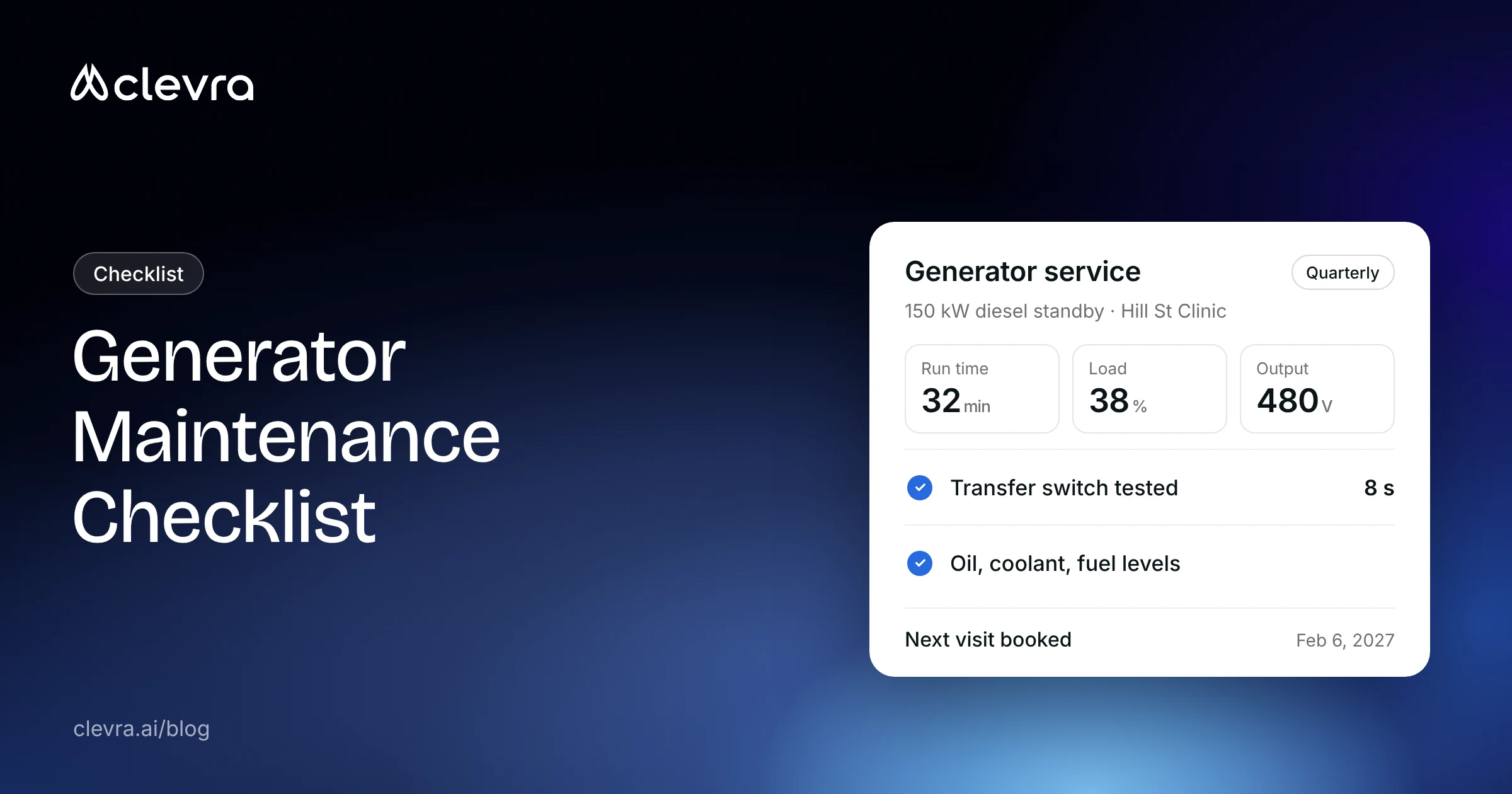
A generator maintenance checklist lists the inspections, tests and service a standby generator needs, by interval, so it starts and carries the load when the power fails. For emergency and legally required systems, NFPA 110 sets the minimum. For home standby units, the manufacturer's schedule does.
The checklist below works for both, with the NFPA 110 items called out. Hospitals and other healthcare sites may also answer to NFPA 99 and their accreditor, and the edition your authority having jurisdiction (AHJ) has adopted is the one that counts.
Reviewed November 6, 2026.
Generator maintenance schedule at a glance
- Weekly: a walk-around inspection of fuel, oil, coolant, batteries, the block heater, leaks and alarms, with the switch in Auto.
- Monthly: exercise under load for at least 30 minutes (NFPA 110), operate the transfer switch and check battery state of charge.
- Quarterly or semiannually: belts, hoses, air filter, fuel filters and transfer switch checks, as the manufacturer sets.
- Annually: oil and filter change (or sooner by run hours), coolant test, diesel fuel quality test, and a load bank test if monthly runs can't reach enough load.
- Every 36 months: a longer load run of up to 4 hours for Level 1 emergency systems, set by their NFPA 110 class.
Weekly generator inspection checklist
- Fuel level in the main tank and day tank, and no water in the fuel.
- Engine oil and coolant at the right levels.
- Block heater working, so the engine is warm to the touch.
- Batteries clean and tight, electrolyte at the right level on flooded types, and the charger working.
- No oil, fuel or coolant leaks under the unit.
- Exhaust system intact, with no soot marks at joints.
- Louvers and air intakes clear.
- Control panel shows no alarms, and the switch is in Auto.
Monthly exercise and transfer test
NFPA 110 asks for diesel units to run at least 30 minutes a month under a load that either reaches the manufacturer's recommended exhaust temperature or is at least 30 percent of the nameplate kW rating. Record on every run:
- Start time and the time to transfer the load
- Voltage on each phase, and frequency (60 Hz in North America)
- Load in kW or as a percentage of nameplate
- Oil pressure, coolant temperature and exhaust temperature where available
- Run time, cool-down time and the run-hour meter
- Any alarms or warnings
Operate the automatic transfer switch on the monthly test, so the switch is proved as well as the engine.
Annual generator service checklist
- Engine oil and oil filter changed, or sooner by run hours.
- Fuel filters and air filter replaced.
- Coolant tested for freeze point and condition; worn hoses and belts replaced.
- Batteries load-tested, and replaced on the manufacturer's schedule.
- Diesel fuel sampled and tested for quality, an annual requirement under NFPA 110; tank checked for water and sediment.
- Spark plugs replaced on gas units, on the manufacturer's schedule.
- Exhaust system, mounts and vibration isolators inspected.
- Transfer switch inspected: contacts, connections and timer settings.
- Controller settings and exercise timer checked.
- Enclosure, louvers and pad in good condition.
Load bank testing
A load bank test runs the generator against an artificial load to prove it can carry its rating and to burn off deposits from running light. NFPA 110 calls for one each year on diesel units whose monthly runs can't meet the 30 percent load or exhaust temperature requirement. Running too lightly for too long causes wet stacking, where unburned fuel builds up in the exhaust.
The steps depend on the edition your AHJ uses. An older edition still followed at many healthcare sites runs 25 percent for 30 minutes, 50 percent for 30 minutes and 75 percent for 60 minutes, two hours in all. Newer editions run 50 percent for 30 minutes and then 75 percent for 60 minutes. Record readings at regular intervals through the test and attach them to the report.
Home standby generators
Most home standby generators run a short self-test on a timer, often every week, and need a yearly service: oil and filter, air filter, spark plugs, a battery check and a test under load through the transfer switch. Follow the maker's schedule, which often sets oil changes by run hours too, and service the unit after any long outage.
What goes in a generator service report
- Site, unit make, model, serial number, kW rating and fuel type
- Run-hour meter before and after
- Readings from the run: voltage, frequency, load, oil pressure and temperatures
- Transfer switch test result and transfer time
- Fluid levels, battery voltage and charger output
- Parts replaced and fluids added
- Deficiencies, recommended repairs and the next due date
- Technician name, signature and date
Run generator maintenance in Clevra
Set each contract up as a recurring job in Clevra, quarterly or semiannual, so every visit lands on the schedule without anyone rebooking it. Build a checklist with number fields for hours, voltage, frequency and load, photo questions and a signature, and attach it to the service so it comes with every visit.
- Your tech fills it in on site, in the phone's browser or the Technician app (iOS beta).
- Switch on Client report and the checklist becomes a numbered PDF with your logo and photos, sent to the site contact by email or a secure link.
- Turn worn belts or a failed battery into an estimate on the same job.
- Invoice the visit from the job before you leave.
Checklists and reports come with Pro and Business. See generator maintenance software, electrical contractor software and our guide to maintenance agreements for recurring revenue.
Generator maintenance FAQ
How often should a standby generator be exercised?
NFPA 110 calls for emergency generators to run under load at least monthly for 30 minutes. Home standby units usually run a short automatic self-test on a timer set by the manufacturer, often weekly.
How often does a generator need maintenance?
A weekly inspection, a monthly test run and a full service at least once a year, with oil changes by run hours on units that run often.
What is a generator load bank test?
A test that runs the generator against an artificial load to prove it carries its rating. NFPA 110 calls for one each year on diesel units whose monthly runs don't reach 30 percent of nameplate or the right exhaust temperature.
What is wet stacking?
A buildup of unburned fuel and soot in a diesel generator's exhaust, caused by running at light load for long periods. Running under proper load, or a load bank test, burns it off.
What should a generator maintenance checklist include?
Fluid levels, batteries, leaks, exhaust, the control panel and transfer switch, test run readings, parts replaced and the next due date, organized by weekly, monthly and annual tasks.
Try it on your next service visit
Build the checklist once, set up one contract as a recurring job, and send the service report before you leave the site. The Free plan has no end date, and Pro or Business are free for 14 days, no card needed.
Get Started for Free or Book a Demo.
Sources: Kansas State Fire Marshal, Generator Testing (Fire Fact 082); NFPA 110, Standard for Emergency and Standby Power Systems.



All-in-one operations platform for trades.
You run a crew, not a tech company. Clevra handles the office stuff so you can stay on the tools.