
Table of Contents
Drying Log for Water Damage: Template and Guide

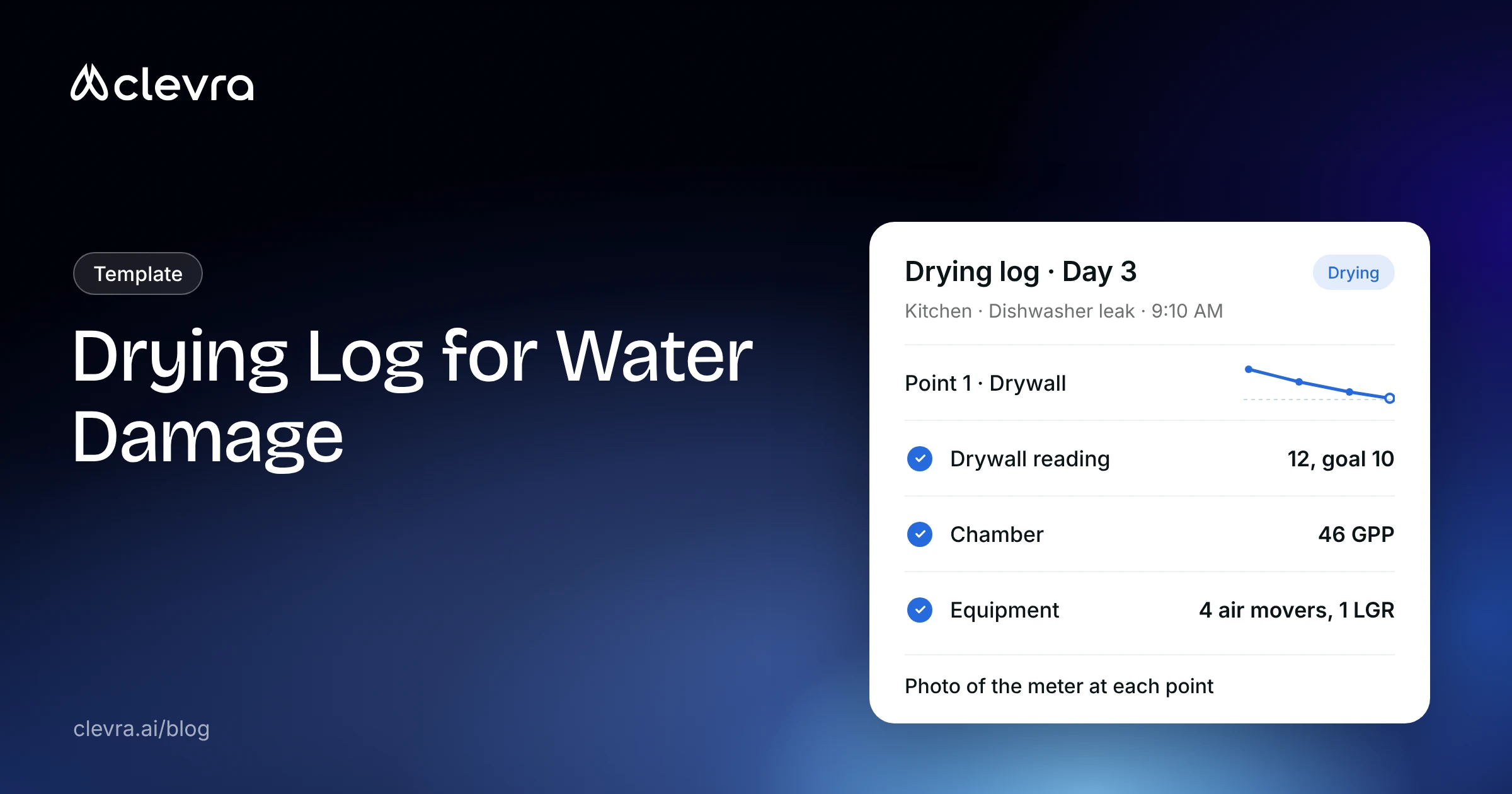
A drying log is the daily record of a water damage job: the moisture readings in each wet material, the temperature and humidity inside and outside the drying area, and the equipment running. It shows the adjuster that the structure was dried to a measured goal, not just left with fans for three days.
This guide covers what to record on every visit, how to take readings that hold up, and a template you can copy. It follows the monitoring practice in the IICRC S500 standard for water damage restoration, which expects drying progress to be checked and documented every day.
Reviewed November 6, 2026.
Why the drying log matters
The drying log is the proof behind every equipment day you bill. Carriers and third-party administrators expect daily readings that start wet and end at a drying goal, and equipment days without readings behind them are the first line an adjuster questions. The log also protects you if mold shows up later, because it shows the materials were dry when the equipment came out.
What to record on every drying visit
A complete drying log has five parts. Copy this template into your own form.
1. Job details (once per job)
- Claim number, carrier and adjuster
- Date of loss and the date drying started
- Source of the water and its category: Category 1 (clean), Category 2 (gray) or Category 3 (black)
- Class of water loss, which describes how much evaporation the job needs
- Affected rooms and materials, with a moisture map sketch
2. Atmospheric readings (every visit)
- Outside: temperature, relative humidity (RH) and grains per pound (GPP)
- Unaffected area inside the building: temperature, RH and GPP
- Each drying chamber: temperature, RH and GPP
- Each dehumidifier: GPP at the intake and at the exhaust
3. Moisture readings (every visit)
- A numbered monitoring point for each wet material, marked on the sketch and on the wall or floor
- The material at each point: drywall, baseboard, subfloor, framing or cabinet base
- The meter used and its mode or scale
- The dry standard: a reading from the same material in an unaffected area
- The drying goal for that material
- Today's reading at each point
4. Equipment (every visit)
- Number of air movers, dehumidifiers (with type, such as LGR or desiccant), air scrubbers and heaters in each chamber
- Equipment added or removed, with the date
- Asset or serial numbers, if your billing needs them
5. Notes and sign-off
- Materials removed and why, and any antimicrobial applied
- What you told the customer
- Photos of the meter at each point
- Technician name, date and time
How to take readings that hold up
Readings only prove progress if they can be compared day to day.
- Same points, every visit. Number each point and mark it, so day 3 is read where day 1 was.
- Same meter and scale. A pin meter on a wood scale and a pinless meter on a reference scale give numbers that can't be compared.
- Set the dry standard first. Read the same material in an unaffected room on day 1. That reading, not a number from memory, sets the goal.
- Use GPP, not just RH. Relative humidity changes with temperature; grains per pound shows the actual moisture in the air. Most thermo-hygrometers calculate it for you.
- Check the dehumidifiers. The drop in GPP from intake to exhaust shows each unit is pulling water out of the air.
- Photograph the meter on the material. A photo with the reading and the point number settles disputes.
How often to take drying readings
Take readings at least once every 24 hours, from the first visit until every point reaches its drying goal. The first visit sets the baseline and the dry standards, and the last visit shows every point at goal before the equipment comes out. If a point stops improving for two visits in a row, change the setup and note why in the log.
Sample drying log entry
Here is how one day might look on a kitchen dishwasher leak. The numbers are an example, not a target.
Day 2, 9:10 a.m. Outside: 52°F, 71% RH, 42 GPP. Unaffected hallway: 70°F, 44% RH, 48 GPP. Kitchen chamber: 78°F, 32% RH, 46 GPP. Dehumidifier 1: 46 GPP at the intake, 22 GPP at the exhaust. Point 1, drywall, north wall, 12 inches above the floor: 28 (dry standard 10). Point 2, subfloor under the dishwasher: 22% (dry standard 12%). Equipment: 4 air movers, 1 LGR dehumidifier. Toe-kick removed under the sink base for airflow.
Common drying log mistakes
- No dry standard, so there is no proof the goal was reached.
- Readings taken at different spots each day.
- No unaffected-area reading to compare against.
- Missing days, especially weekends.
- Equipment counts that don't match the invoice.
Keep the drying log in Clevra
Clevra comes with a Water Damage · First Response starter checklist for the first visit. For daily monitoring, build a drying visit checklist with number fields for each point and atmospheric reading, photo questions and a signature, and attach it to every drying visit on the job.
- Each drying visit is its own visit under one job, so day 1 to day 4 stay together.
- Every photo carries a stamp with who added it and when, on the web and in the PDF.
- Switch on Client report to send the adjuster a numbered PDF with your logo and photos, by email or a secure link.
- Invoice the job from its line items when the equipment comes out.
Clevra stores the readings your tech enters, so use a thermo-hygrometer that shows GPP. Checklists and reports come with Pro and Business. See water damage restoration software, our guide to water damage documentation for insurance claims, and mold remediation software.
Drying log FAQ
What is a drying log?
A daily record of moisture readings, temperature, humidity and equipment on a water damage job. It shows wet materials drying to a goal and supports the equipment days on the invoice.
How often should moisture readings be taken during drying?
At least once every 24 hours, at the same points with the same meter, until every point reaches its drying goal.
What is a dry standard?
A moisture reading from the same type of material in an unaffected part of the building. It shows what dry looks like for that material and sets the drying goal.
What does GPP mean in water damage restoration?
Grains per pound, a measure of how much water vapor is in the air. Unlike relative humidity, it doesn't change with temperature, so it's the better number for comparing rooms and days.
Do insurance adjusters require a drying log?
Most carriers and third-party administrators expect daily drying records to support equipment charges, and missing days are a common reason invoices get questioned.
Try it on your next water job
Set up one drying checklist, run it on your next loss, and send the adjuster the report the day the fans come out. The Free plan has no end date, and Pro or Business are free for 14 days, no card needed.
Get Started for Free or Book a Demo.
Source: IICRC S500, Standard for Professional Water Damage Restoration.



All-in-one operations platform for trades.
You run a crew, not a tech company. Clevra handles the office stuff so you can stay on the tools.