Table of Contents
Service Fusion Alternatives and Competitors (2026)


Service Fusion makes one promise most field service software won’t: unlimited users at a fixed monthly price. If you run 20 or 30 techs across HVAC, plumbing, roofing or solar, that promise is worth a lot. You hire, the bill stays put.
The flip side shows up at the small end. Starter is $208 a month on annual billing, whether you have 25 people or 3. For a two-person septic inspection business or a GPR scanning crew of four, that’s a big fixed cost for seats nobody sits in. And there’s no trial listed, only a demo.
So this guide is about Service Fusion alternatives for crews of 1 to 15, sorted by what they cost at your actual headcount. We make Clevra, so it’s listed first. We also point out where Service Fusion wins, and at 20+ users it often does.
Every price below was checked on the vendor’s own pricing page on October 15, 2026.
Service Fusion alternatives: the quick answer
- Clevra: crews of 1 to 15 in concrete scanning, utility locating, septic inspection and roof inspection that need on-site forms and PDF reports. Free plan, flat price.
- Jobber: residential crews that want self-booking, Tap to Pay, ACH and an app marketplace.
- Housecall Pro: home service shops that want polished iOS and Android apps, financing and AI call booking.
- Kickserv: small teams that want $60 for 5 users, QuickBooks Desktop or Online, and a 30-day trial.
- RazorSync: 2 to 15 person teams that want listed prices, an API and route optimization on the top plan.
- FieldEdge: HVAC and plumbing shops built around a flat-rate pricebook.
- Workiz: phone-heavy businesses that want a built-in phone system and AI answering.
Why small teams look for a Service Fusion alternative
Service Fusion’s model fits big teams. The friction comes from being small. These are the usual reasons.
1. You pay for unlimited seats you don’t use. Annual pricing is $208 a month for Starter, $325 for Plus and $533 for Pro. Month to month, it’s $245, $382 and $627. At 25 users, Starter works out to about $8 per person. At 3 users, it’s about $69 per person.
2. There’s no trial to test on real jobs. Service Fusion offers a demo; a trial isn’t mentioned. You see the software, but you don’t get to run a week of your own visits through it before paying.
3. “Concrete” means pouring, not scanning. Service Fusion lists concrete among its trades, which makes sense for flatwork and foundation contractors. A scanning crew works the other side of that slab. Before anyone cores or saw-cuts, the GPR tech maps rebar, post-tension cables and conduit, then hands over a marked layout and a report. Different job, different paperwork.
4. You want the report to build itself. A septic inspection for a home sale needs tank size, baffle condition, liquid level and drain field observations. A roof inspection needs slope-by-slope photos and notes on flashing, vents and gutters. If those fields aren’t structured, someone types them up after dinner.
Service Fusion competitors at a glance, by price
Monthly cost in USD on annual billing unless noted, as listed October 15, 2026. FieldEdge and Workiz don’t publish prices.
- Service Fusion (for reference): $208/mo (Starter), unlimited users. No free plan. Demo, no trial mentioned. Best for teams of 20 or more.
- Clevra: $0 for 1 user; $39/mo for up to 5 (Pro); $79/mo for up to 15 (Business). Free plan. 14-day trial, no card. Best for scanning, locating and inspection crews of 1 to 15.
- Jobber: $29/mo for 1 user; $149 for 5 on Connect; extra users $29. No free plan. 14-day trial. Best for lawn care, cleaning and handyman.
- Housecall Pro: $59/mo for 1; $149 for 5; $299 for 8, then $35 per user. No free plan. 14-day trial. Best for residential home service.
- Kickserv: $60/mo for 5 users; $119 for 10; $199 for 20; billed monthly, 20% off yearly. No free plan. 30-day trial. Best for cost-conscious small shops.
- RazorSync: $85/mo for up to 2; $195 for up to 7; $439 for up to 15. No free plan. 14-day trial. Best for teams that want an API.
- FieldEdge: request pricing, by technicians and add-ons. No free plan. No free trial. Best for HVAC and plumbing.
- Workiz: request pricing. No free plan. 7-day trial. Best for phone-first shops.
What a 4-person crew pays on annual billing: Clevra Pro $39, Kickserv Start $60 (monthly), Jobber Connect $149, Housecall Pro Essentials $149, RazorSync Team $195, Service Fusion Starter $208. At 15 people: Clevra Business $79, Service Fusion Starter $208, Jobber Connect $299, RazorSync Pro $439, Housecall Pro MAX with 7 extra users $544. At 25 people, Service Fusion’s $208 is hard to beat, and Clevra moves to Custom pricing.
The 7 best Service Fusion alternatives, compared
1. Clevra: for scanning, locating and inspection crews of 1 to 15
Clevra is one web app that runs a job from the first call to the paid invoice, with a Technician app beta for iOS on TestFlight. It’s built for crews of 1 to 15 in trades where the client pays for findings: concrete scanning and GPR, utility locating, septic inspection and roof inspection, plus everyday HVAC service and plumbing.
Scanning before the core drill. A GC calls: they need four 6-inch cores through a suspended slab by Thursday. Your tech scans each location, marks the rebar and tendons on the deck, notes slab thickness and clearance, photographs the layout and gets the superintendent to sign off before the driller starts. That signed record is what protects everyone if something gets hit.
Clevra’s job checklists capture exactly that (Pro and up). Build the form once using text, number, checkbox, dropdown, date, yes/no, photo upload and signature fields, and make the must-haves required. The tech fills it at the core location, Clevra turns it into a PDF, and the GC opens it in the Clevra client portal. Photo and signature questions are filled from the web app for now. Our GPR report template lists the fields scanning firms use most.
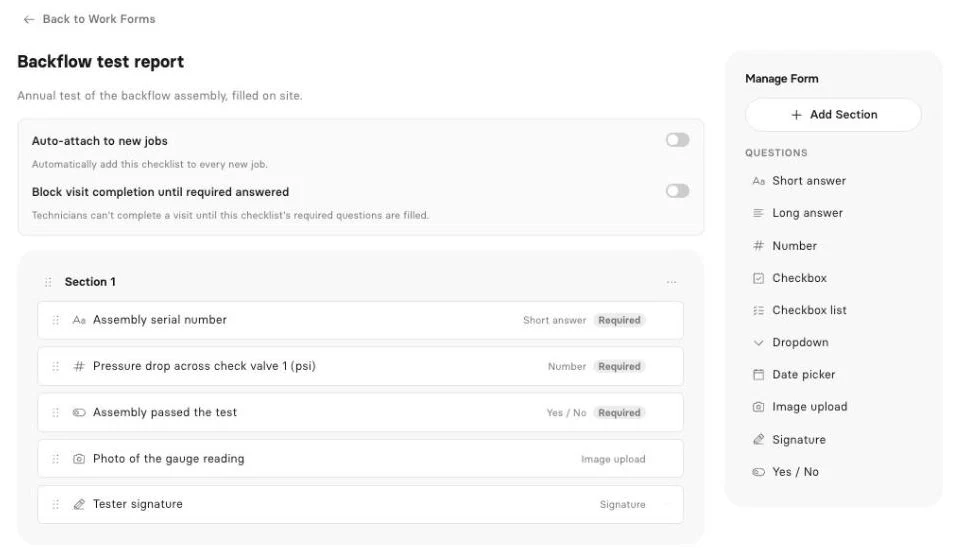
The same tool covers a septic inspection the next day (tank size, baffles, levels, drain field notes) or a roof inspection with photos by slope. One account, a different checklist per service.
Early access: inspection reports. Clevra’s inspection reports feature drafts a client-ready report from what the crew captured on site. It’s in Early access. Book a demo to see it with your own layout.
Early access: AI Receptionist. Service Fusion already offers an AI phone answering service. Clevra’s AI Receptionist answers the business line, notes who’s calling and why, and puts the request in your inbox for the office to book. It’s in Early access; schedule a 30-minute demo if you want to try it.
AI that ships today. On Pro and up, the Clevra AI Business Assistant answers plain-English questions from your live data: “Which GCs owe us more than 30 days?” or “What did we bill on scanning last month?” The Model Context Protocol server connects your account to Claude, ChatGPT or any MCP assistant. It can look up jobs, find open slots, draft an estimate or book a visit, and it asks before every change.
From estimate to paid. Estimates with online approval and signature, plus automatic follow-ups on Pro. Jobs and visits on a calendar with day, week and month views, a map and recurring visits. Invoices from the job, Stripe card payments in USD with no Clevra platform fee, and cash, cheque or e-transfer recorded by hand. 23 reports, job costing, timesheets and QuickBooks Online sync on Pro and up. Two-way texting and automations too.
Pricing. Flat per company, never per seat:
- Free: $0 for 1 user, no time limit
- Pro: $49 a month, or $39 a month billed yearly, up to 5 users
- Business: $99 a month, or $79 a month billed yearly, up to 15 users
- Custom: unlimited users, pricing on request
Unlike a demo-only process, new accounts can trial Pro or Business for 14 days without a card.
Where Service Fusion is stronger. Unlimited users on every plan, GPS tracking, service agreements, inventory, progress billing, eSign and an AI phone answering service that’s live. Clevra has no GPS tracking, inventory, progress billing or service agreement billing module. If you’re past 15 people or bill large jobs in stages, Service Fusion has the edge.
For a line-by-line breakdown, see Clevra vs Service Fusion.
2. Jobber
Jobber prices by plan and team size. On annual billing, Core is $29 a month for 1 user, Connect ranges from $99 for 1 to $299 for 15, and Grow from $149 to $399. Each extra user is $29. There’s a 14-day trial with Grow features and no card.
Online self-booking, Tap to Pay, ACH and a large app marketplace stand out, with iOS and Android apps. It suits residential recurring work more than technical reporting. See a closer look at Jobber.
3. Housecall Pro
Housecall Pro charges $59 a month for 1 user, $149 for 5 and $299 for 8 on annual billing, then $35 per extra user. Monthly prices are $79, $189 and $329. The trial is 14 days, no card.
Apps in English and Spanish, offline mode, GPS tracking, online booking, financing, payroll and CSR AI that books jobs. Great for home service; past 8 people the per-user charge adds up. See Housecall Pro head to head.
4. Kickserv
Kickserv is the budget answer to Service Fusion’s entry price. Start is $60 a month for 5 users, Run $119 for 10, Scale $199 for 20, billed monthly, 20% off yearly. The trial is 30 days.
QuickBooks Online and Desktop, Tap to Pay, digital signatures, onsite card payment, and iOS and Android apps with GPS and time tracking. A sound pick for plumbing, restoration or construction crews that need the basics done well. See Kickserv in detail.
5. RazorSync
RazorSync’s tiers line up with small teams: Solo $85 a month for up to 2 users, Team $195 for up to 7, Pro $439 for up to 15 on annual billing ($90, $225, $499 monthly). Enterprise is unlimited on request. There’s a 14-day trial.
It includes iOS and Android apps, a customer portal, time cards, payroll and an API. QuickBooks Desktop and Online sync starts on Team, and route optimization and inventory come with Pro. See RazorSync, feature by feature.
6. FieldEdge
FieldEdge targets HVAC, plumbing, electrical, locksmith and appliance repair. Select, Premier and Elite are all request pricing, based on technician count and add-ons, and there’s no free trial; FieldEdge says its onboarding works better than one. Mobile licenses are capped at 2, 4 and 6 by plan.
Every plan has a flat-rate pricebook, dispatching, payments, SMS, lead tracking and QuickBooks Online and Desktop. Higher tiers add service agreements, call recording and warehouse inventory. See FieldEdge compared with Clevra.
7. Workiz
Workiz lists Standard, Pro and Ultimate with request pricing and a 7-day trial, no card. Its focus is the phone: Genius AI Answering, Genius Phone, plus online booking, route planning, inventory and service plans.
If your Service Fusion setup leaned on its AI phone answering, Workiz is the closest swap on that front. See the Workiz rundown.
Free Service Fusion alternatives
Service Fusion has no free plan and no listed trial. Most alternatives offer a time-limited trial instead.
Clevra has a Free plan at $0 for one user with no time limit. It includes clients, estimates, jobs, scheduling, invoices, the client portal and online card payments. Clevra branding appears on estimates, invoices and the portal. Checklists and AI features start on Pro. A solo locator or an owner-operator septic inspector can book, invoice and get paid on it while deciding whether to grow.
Trials elsewhere: Kickserv 30 days; Jobber, Housecall Pro and RazorSync 14 days; Workiz 7 days. FieldEdge doesn’t offer one.
Software like Service Fusion: the field test
Service Fusion includes a technician mobile app with GPS tracking. Whatever you switch to, test the mobile side with a real crew member, on a real job site, for a full day:
- Can they see their visits, open directions and tap On My Way?
- Can they fill the scan, locate or inspection form you send clients?
- Do timesheets keep running on an underground parking deck with no signal?
- Can they invoice and record payment on site?
Clevra, honestly: the Technician app is an iOS beta on TestFlight. It’s not on the App Store and there’s no Android app yet. It covers the tech’s day, visit details, directions, Start, On My Way and Complete, checklist filling (photo and signature questions are web-only for now), a visit timer and timesheets that work offline, invoice creation and manual payment recording for cash, cheque, card or e-transfer. There’s no GPS tracking, Tap to Pay or broader offline mode.
If your crew is on Android or needs full offline mode today, Jobber, Housecall Pro, Kickserv and RazorSync have more complete apps.
How to choose among Service Fusion competitors
- You have 20+ users: Service Fusion’s unlimited seats probably still win. Stay or compare against Kickserv Scale.
- You’re 1 to 15 people and every job ends in a report: Clevra. Our piece on reports and job costing shows how the two connect.
- You need progress billing on big jobs: Service Fusion.
- You need QuickBooks Desktop: Kickserv, RazorSync or FieldEdge.
- You run HVAC or plumbing on flat-rate pricing: FieldEdge.
- Calls drive your business: Workiz or Housecall Pro.
How to switch from Service Fusion
- Export your customers. Pull clients and job sites into a spreadsheet.
- Import into Clevra. Upload a CSV or XLSX of up to 5,000 rows. A GC with a dozen job sites stays one client with multiple properties.
- Load your services. GPR scan per location or per hour, private locate, septic inspection, roof inspection.
- Build a checklist per service. Required fields for what the client must see: slab thickness, line depth, tank level, roof slope photos.
- Connect Stripe and QuickBooks Online. Details on the integrations page.
- Add your request form. Embed Clevra’s job request form on your site.
- Overlap for a couple of weeks. Finish open work in Service Fusion, book new work in Clevra, then cancel.
Service Fusion alternatives FAQ
Is Service Fusion good for small business?
It depends on how small. Service Fusion’s unlimited users are excellent value at 20 or more people, but Starter costs $208 a month on annual billing regardless of headcount. For a crew of 2 to 5, that’s a high fixed cost compared with tools priced for small teams, and there’s no trial to test it first.
Does Service Fusion have a free trial?
Service Fusion offers a demo, and a free trial isn’t mentioned on its pricing page as of October 15, 2026. There’s no free plan. Plans run $208, $325 and $533 a month billed annually, or $245, $382 and $627 month to month, all with unlimited users.
Is there a free alternative to Service Fusion?
Yes. Clevra’s Free plan is $0 for one user with no time limit. It covers clients, estimates, jobs, scheduling, invoices, a client portal and online card payments. When you add people, Pro is $39 a month billed yearly for up to 5 users, and new accounts can trial paid plans for 14 days.
Who are Service Fusion’s main competitors?
Service Fusion competitors include Jobber, Housecall Pro, Kickserv, RazorSync, FieldEdge, Workiz and ServiceTitan. Kickserv and RazorSync are closest on published pricing. Clevra competes for crews of 1 to 15 in concrete scanning, utility locating, septic inspection and roof inspection, where structured on-site reports matter most.
Does Clevra have an AI receptionist?
Clevra’s AI Receptionist is in Early access. It answers your business line, notes who called and what they need, and drops the request into your inbox so the office can book it. Book a demo to try it. Clevra’s AI Business Assistant is already live on Pro and Business for questions about your own data.
Can Clevra handle concrete scanning reports before coring?
Yes. Concrete scanning is one of the trades Clevra is built around. On Pro and up, build a checklist with slab thickness, rebar and tendon notes, layout photos and a sign-off signature. The crew fills it on site, Clevra makes a PDF, and the GC sees it in the client portal.
Try Clevra on your next scan or inspection
No demo required to get started. Run your next GPR scan, locate, septic or roof inspection in Clevra. The Free plan has no expiry, and Pro or Business include a 14-day trial with no card. The comparison hub covers other tools if you’re still shopping.
Get Started for Free or Book a Demo to see inspection reports and the AI Receptionist in Early access.




All-in-one operations platform for trades.
You run a crew, not a tech company. Clevra handles the office stuff so you can stay on the tools.